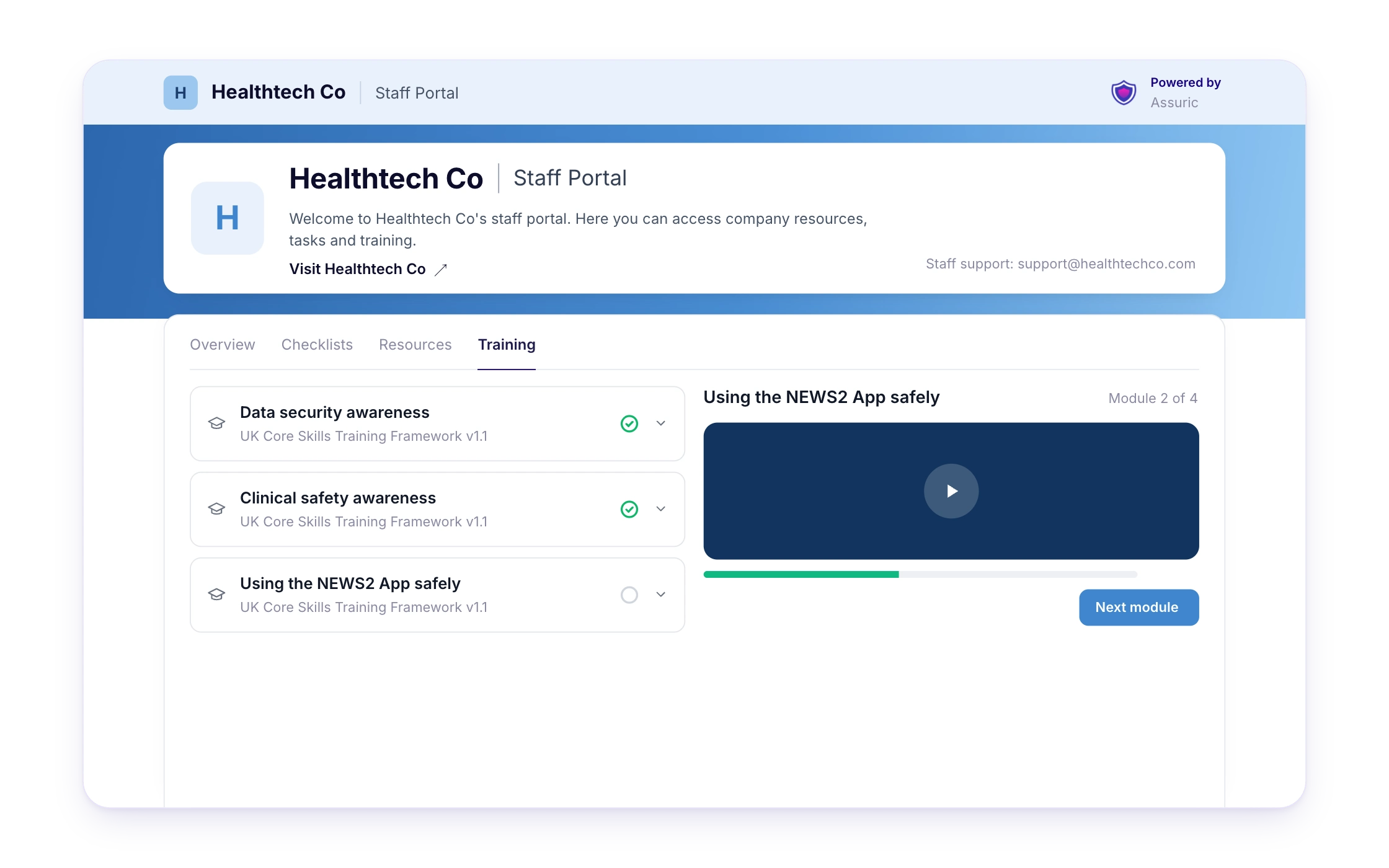
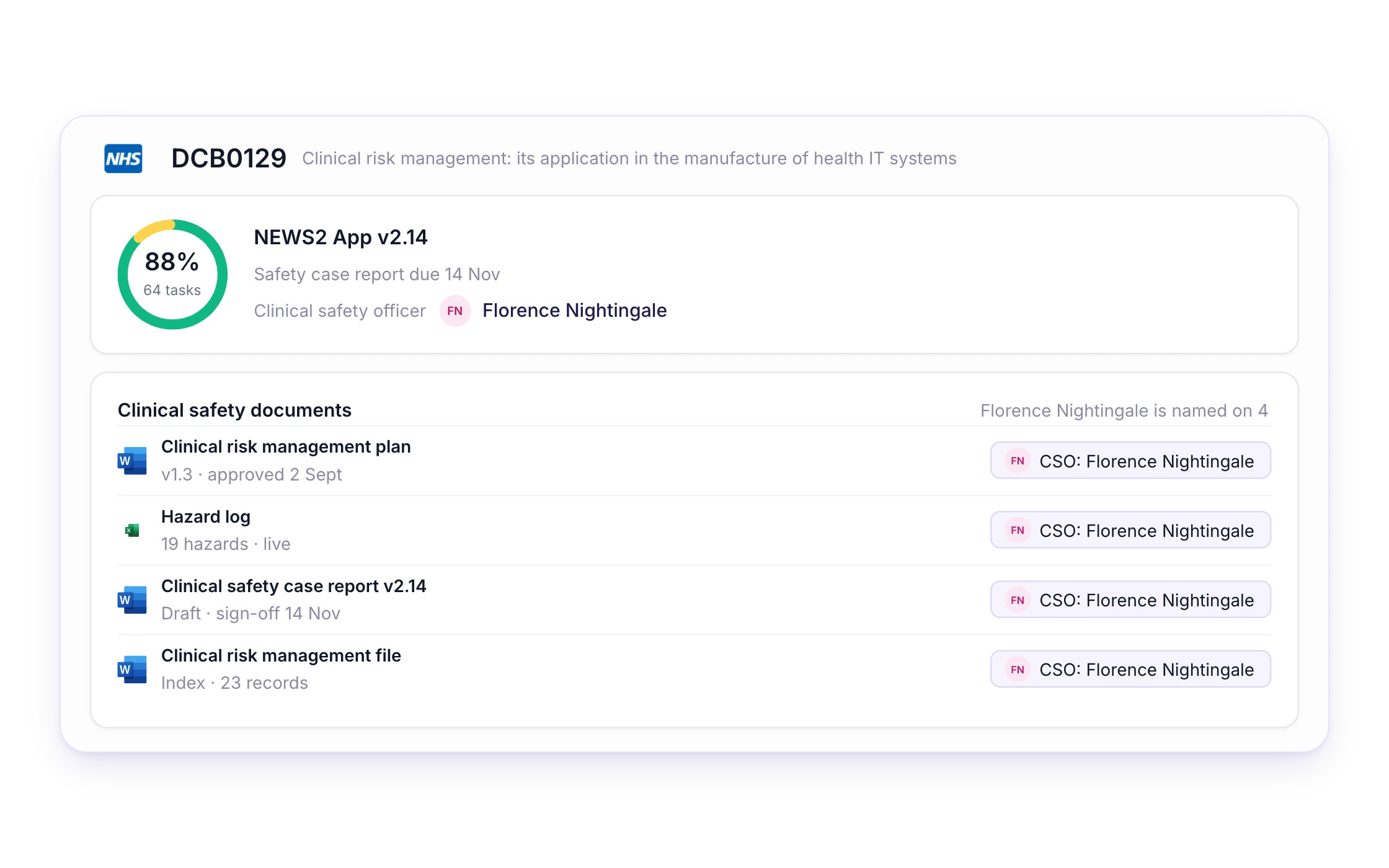
Spend less time on manual work
Templates designed by clinical safety officers, live hazard log data and linked records take care of the repetitive work, so producing and updating your DCB0129 documents takes minutes, not a quarterly clean-up.
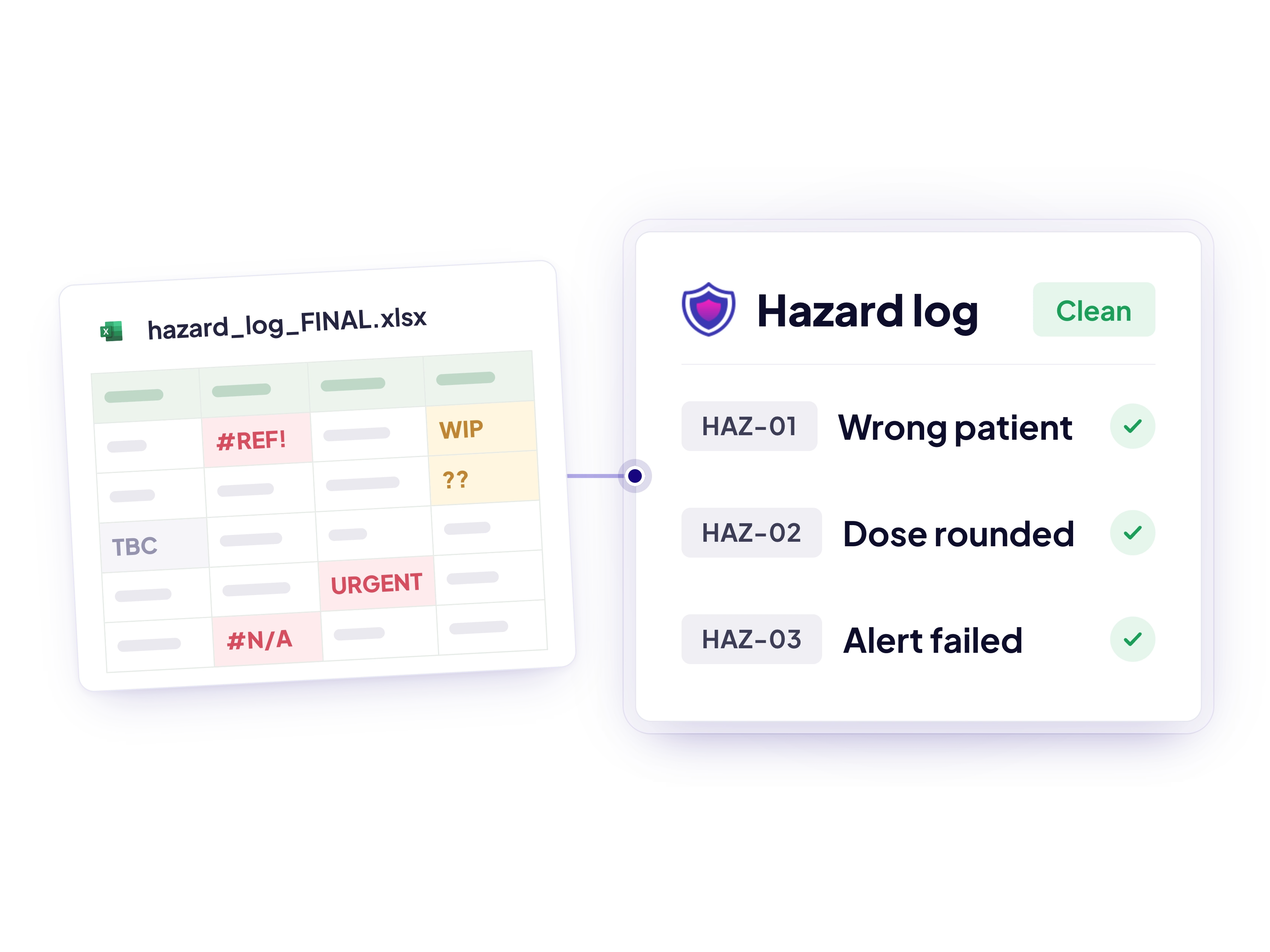
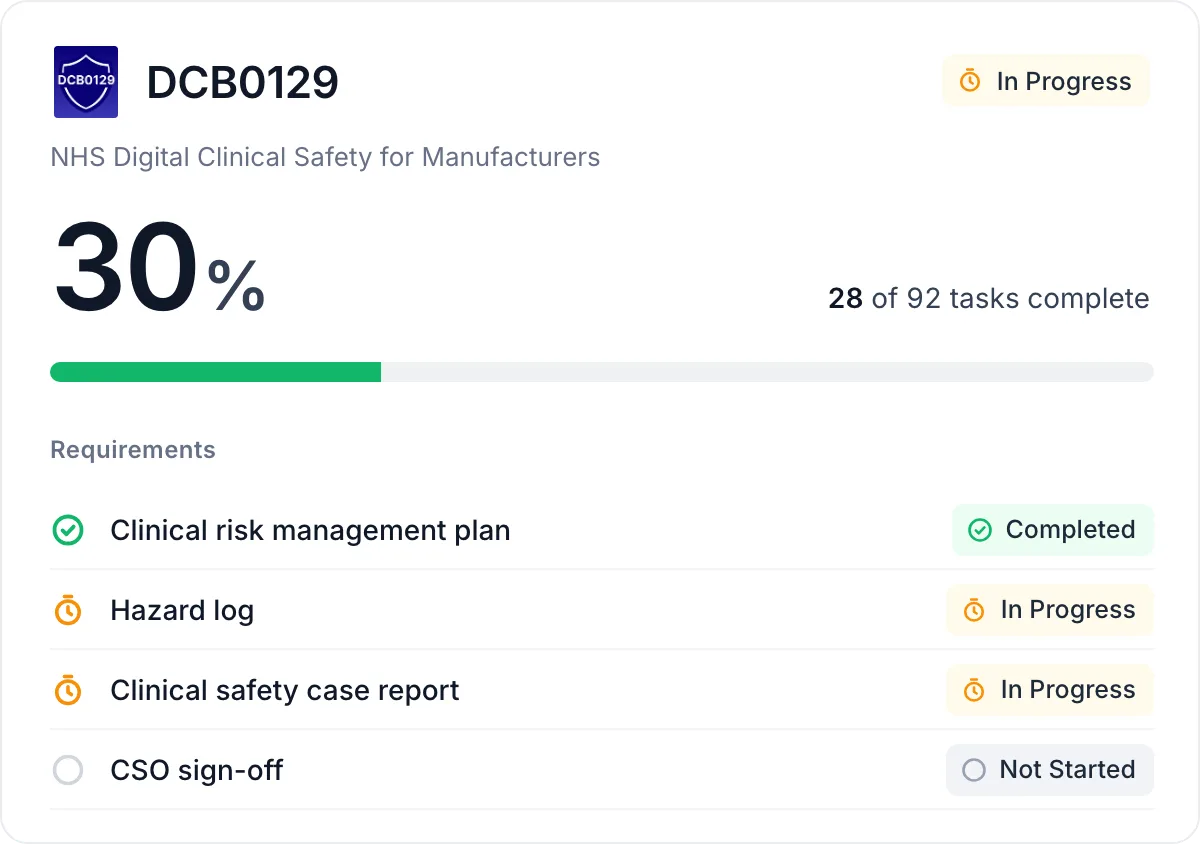
Assuric gives you the hazard log, clinical safety case, incident management and CSO support to meet DCB0129, all in one place.
Trusted by teams deployed in the NHS


Features
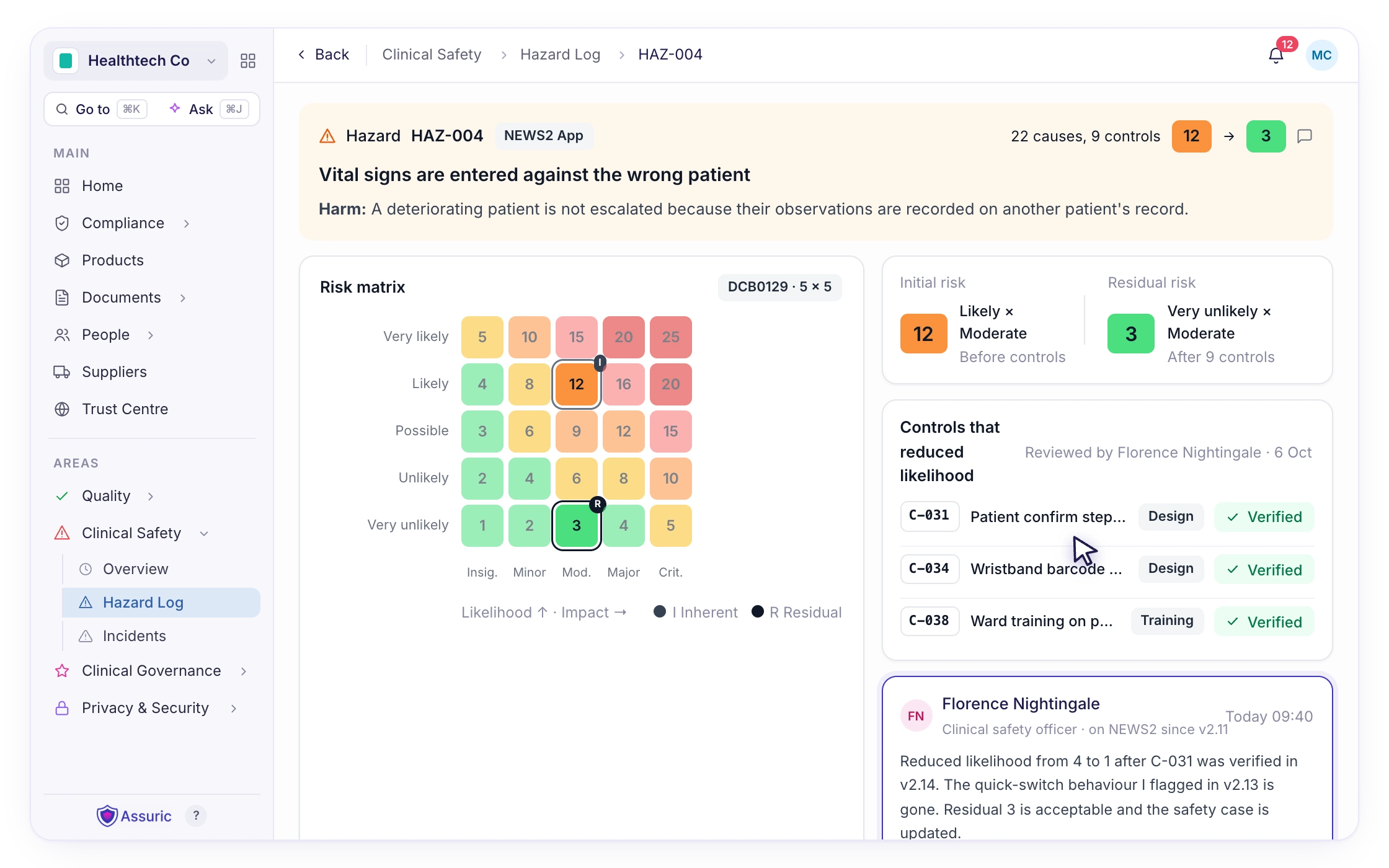
Hazard log
Designed by clinical safety officers. Link hazards, causes, controls and evidence, score risk on your own matrix and get AI suggestions, across every product.
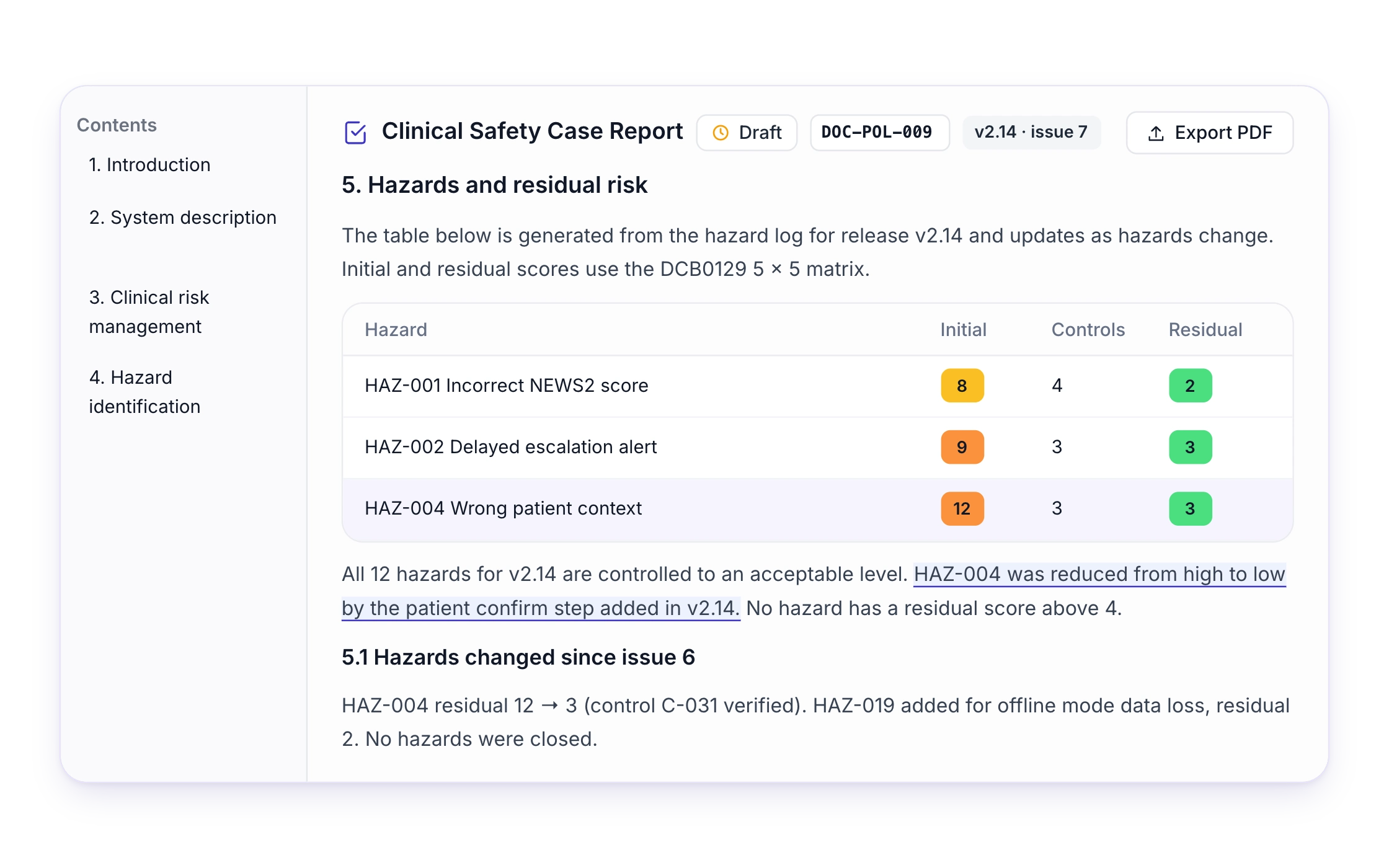
Document & report management
Generate your clinical safety case report from your live hazard log, and create your clinical risk management plan and policies from templates, with owners, reminders, version control and CSO approval built in.
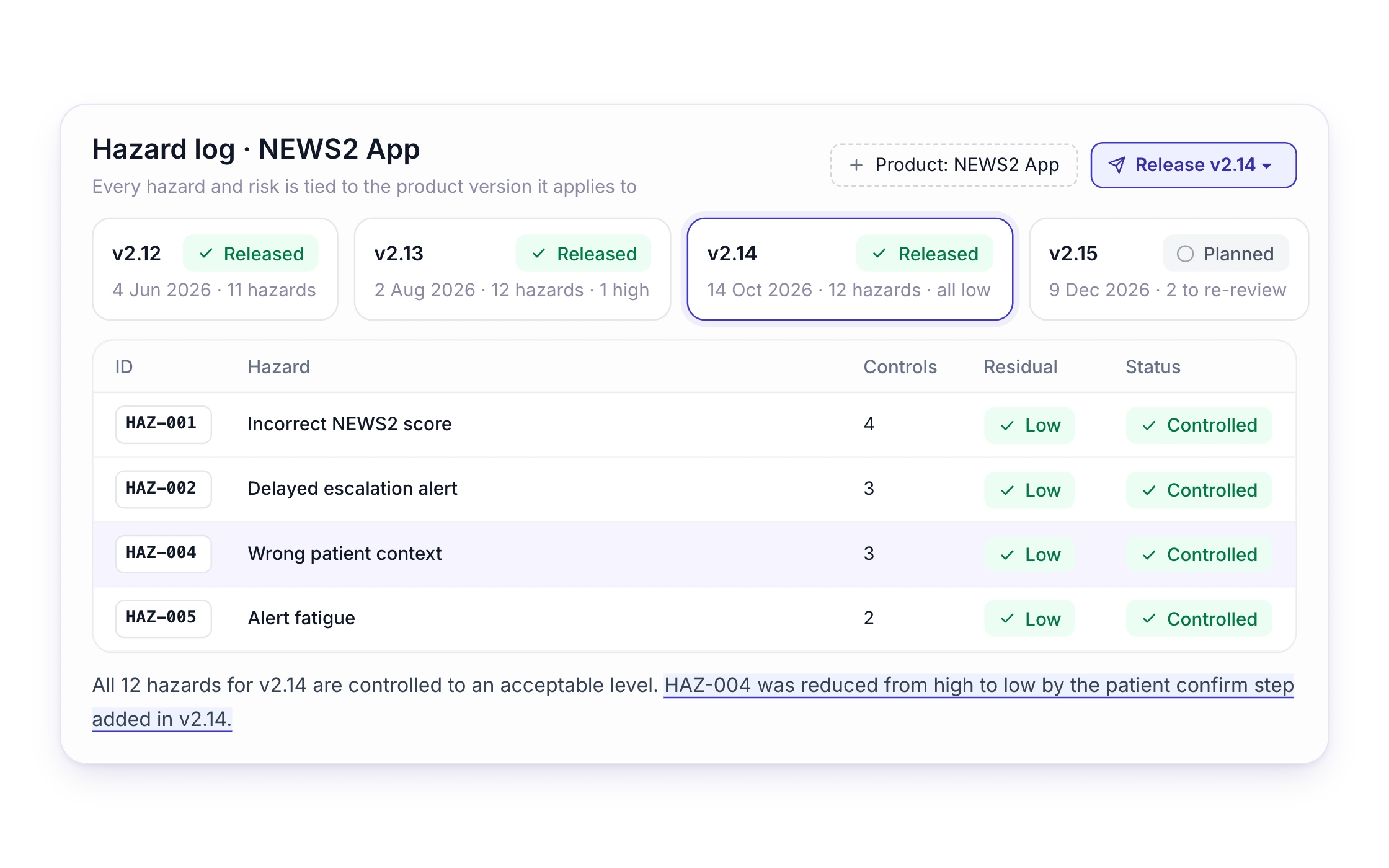
All-in-one compliance
Run multiple complex projects side by side, linking hazards, causes and controls across them so the same work is not done twice.
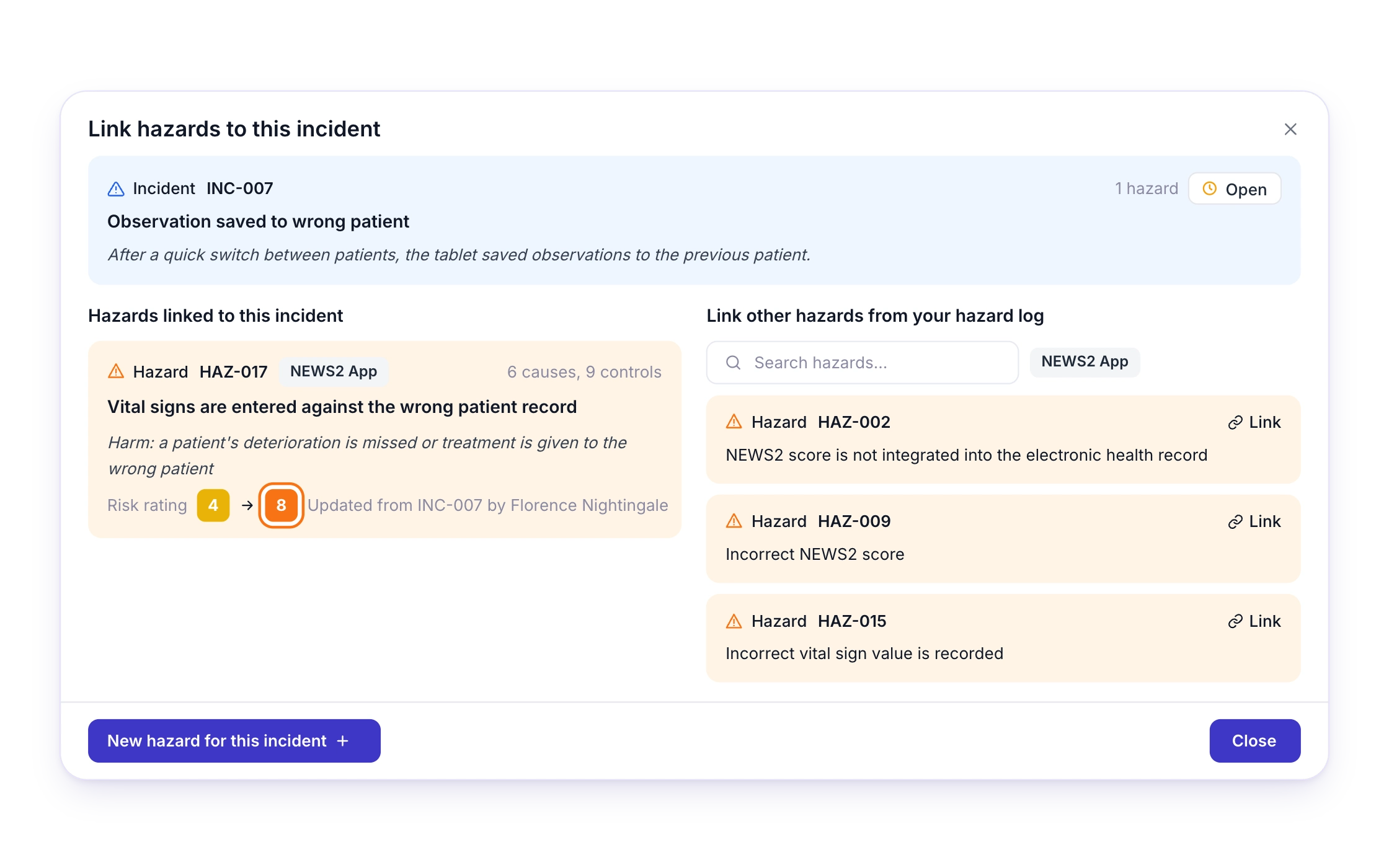
Incident management
Log and investigate clinical incidents with owners assigned, and flag the hazards and controls each one affects for reassessment.
Benefits
Templates designed by clinical safety officers, live hazard log data and linked records take care of the repetitive work, so producing and updating your DCB0129 documents takes minutes, not a quarterly clean-up.
Hazards, controls, evidence and approvals stay linked, so DTAC reviewers and NHS buyers can click from each risk to the proof instead of waiting for you to pull a folder together.
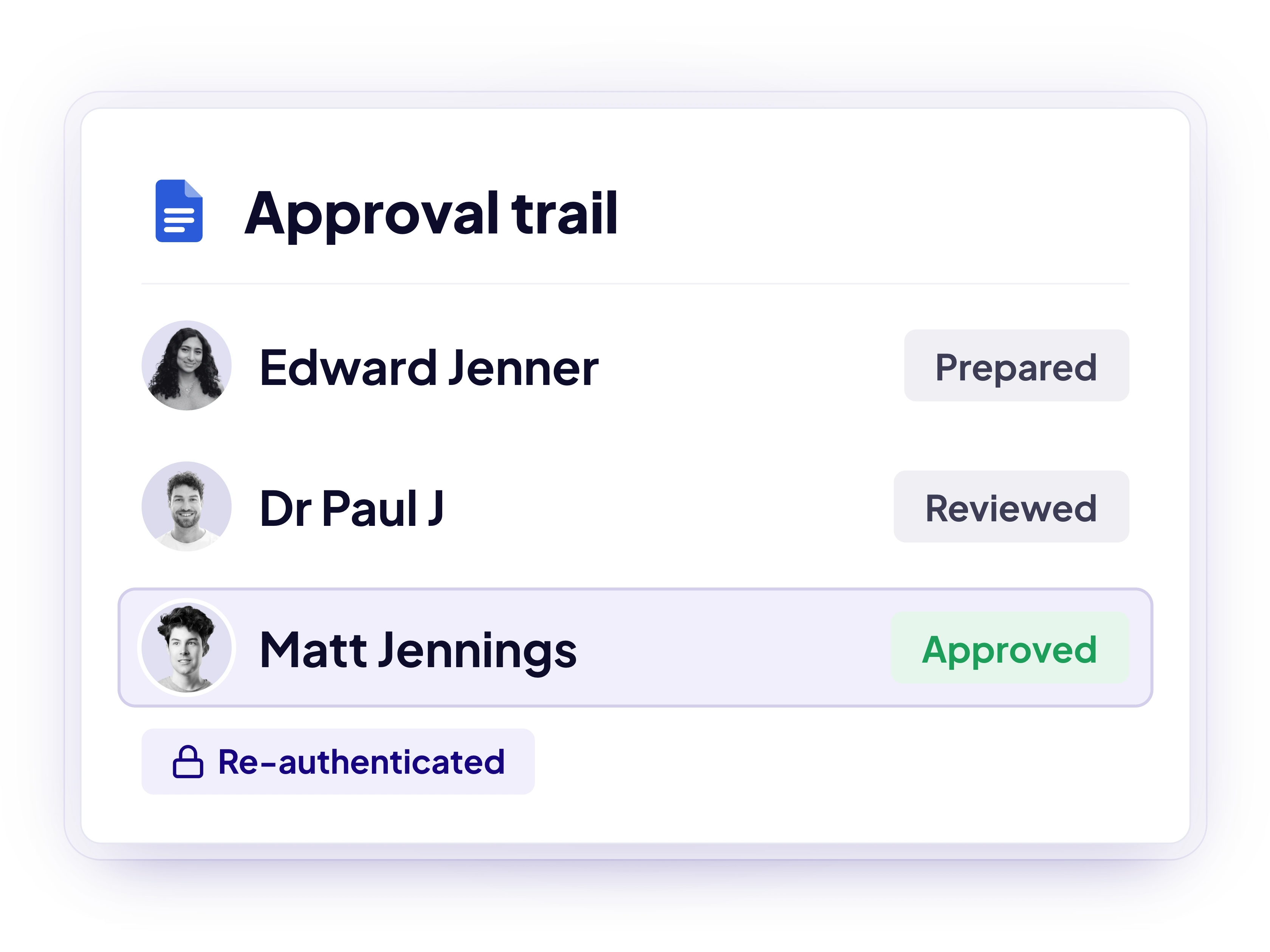
AI suggests hazards, causes and controls based on your product and its intended use, and drafts updates to your safety case from your live hazard log, so your CSO reviews and approves rather than writing from scratch.
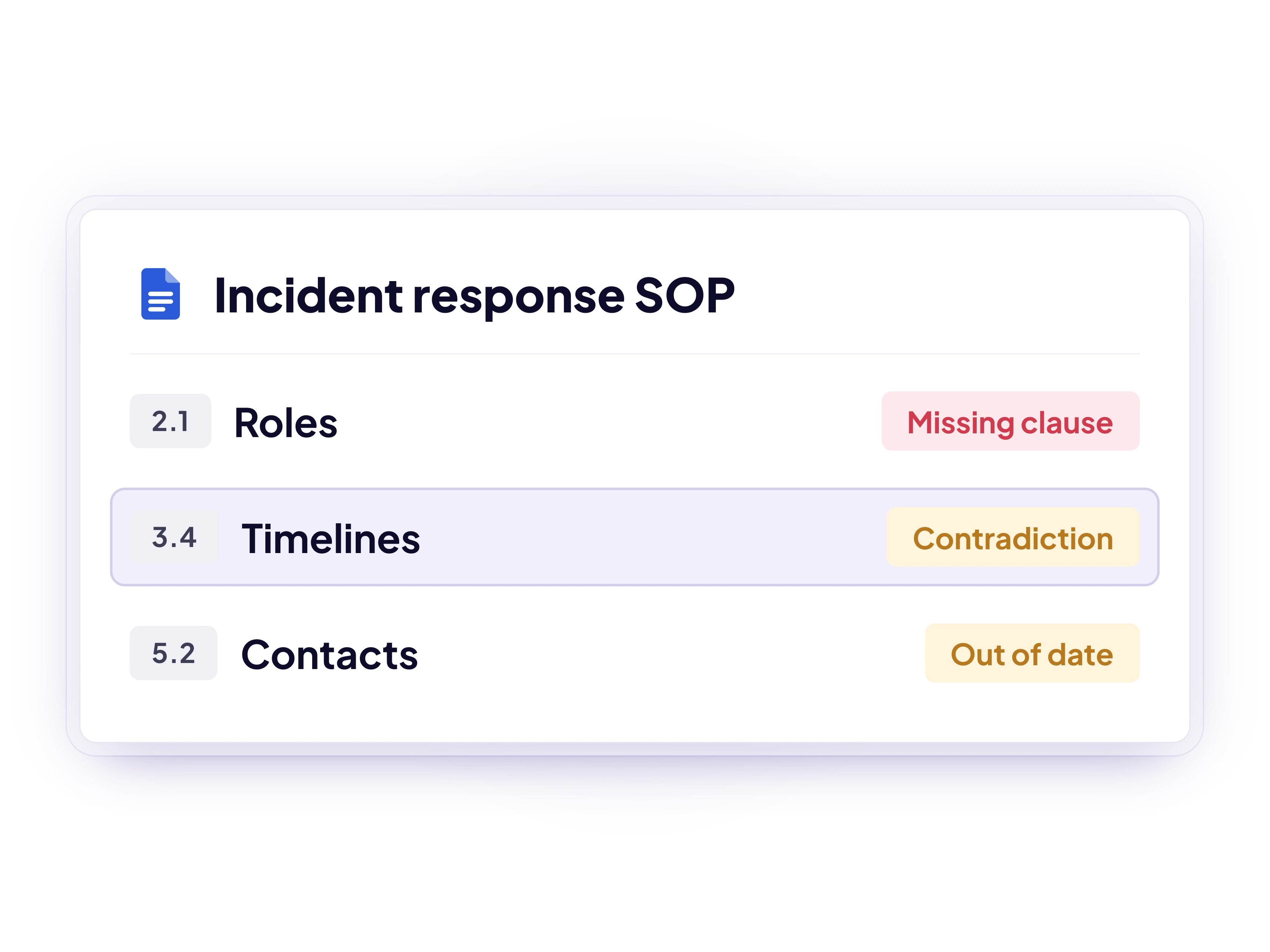
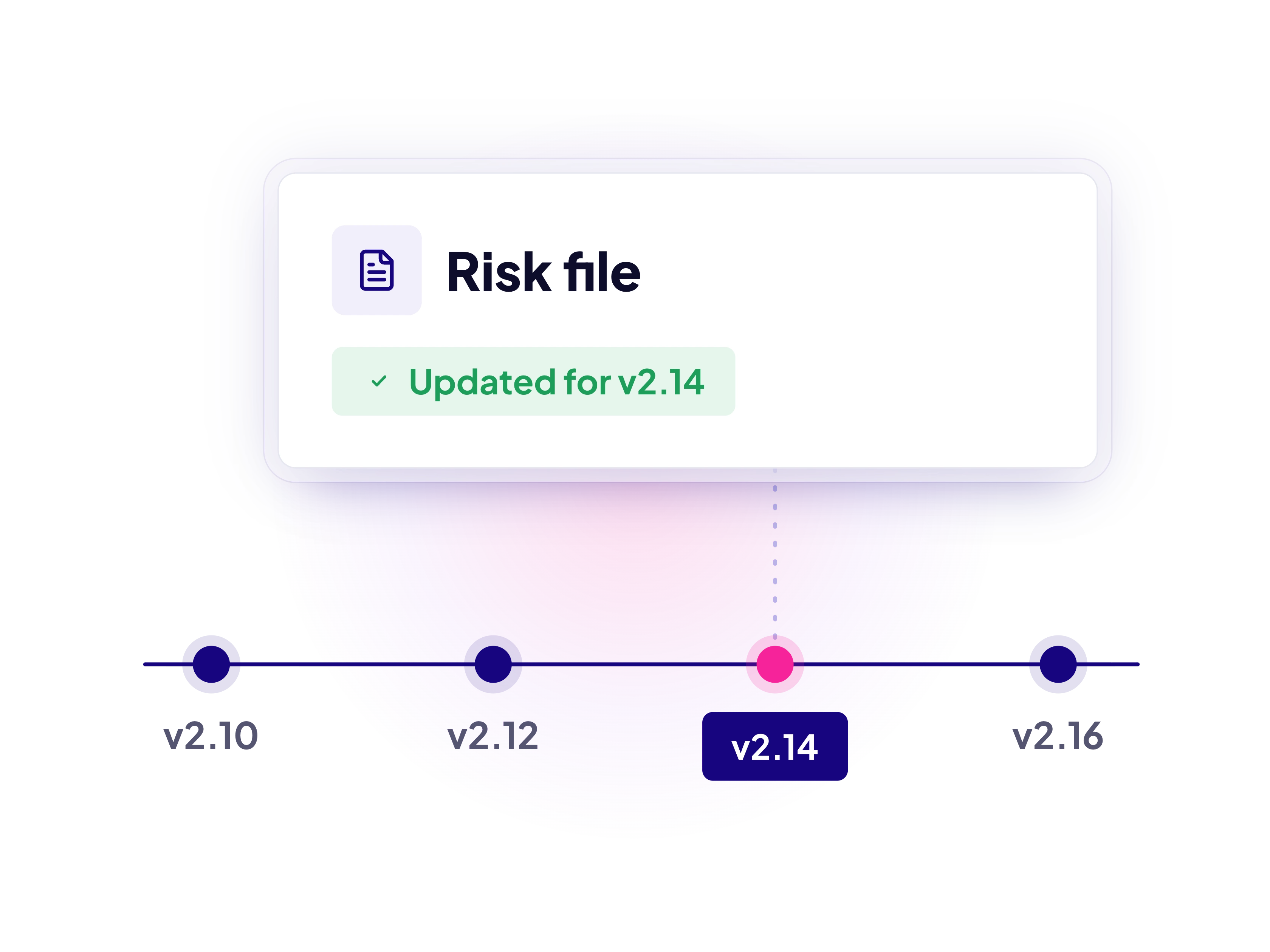
Releases and incidents flag the hazards they affect for reassessment, and every issue of your safety case is kept, so your CSO reviews what changed and you can show how clinical risk has moved over time.
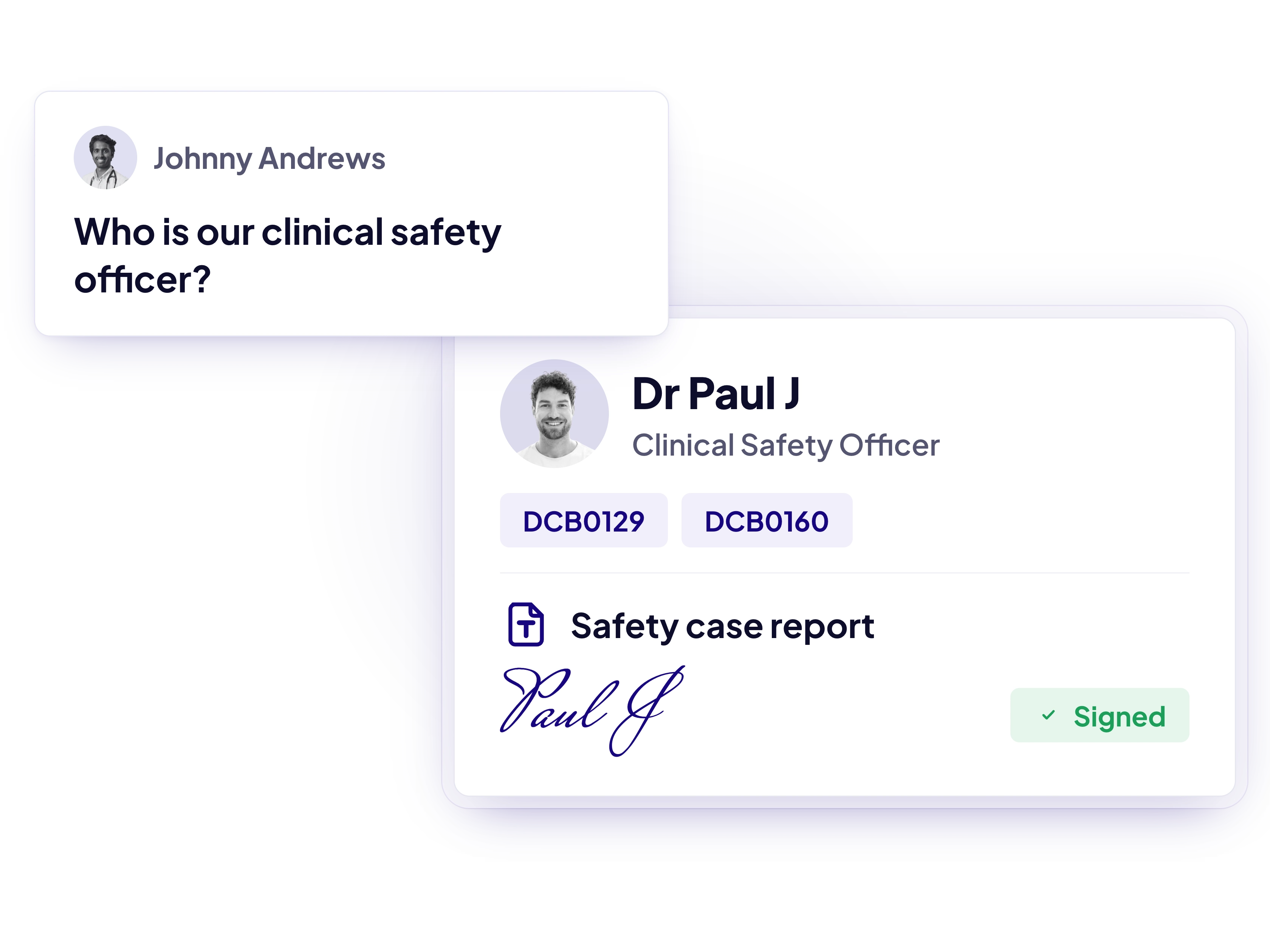
Our clinical safety officers work in your workspace, become fluent in your product and sign your DCB0129 documents, while Assuric’s automation keeps their time on expert advice, not admin.

“We couldn't speak highly enough of both the Assuric team and the platform itself, which is incredibly easy to use, and with the skill and hardworking nature of the Assuric team. They've been a key component in accelerating our progress and deployments!”
Maks Kozarzewski
COO, VitVio

“The Assuric platform is a game changer in the clinical risk management field. It has been carefully designed to make the job of a CSO significantly more streamlined. The team are excellent and responsive to any product suggestions I have requested, and it has been a pleasure to work with them.”
Paul Llewellyn
CCIO, Accenture

“Assuric has been fantastic in helping us quickly and safely navigate regulatory compliance in the UK. From completing Cybersecurity requirements to DSPT, DCB0129, and DTAC, the team was supportive, extremely knowledgeable, and the platform made everything quick and straightforward. A separate regulatory company we consulted at the beginning even remarked on how quickly we achieved compliance!”
Katie Baker
Director UK & Ireland, Tandem
Get in touch if we haven't answered your question below, and we’ll always be happy to help!
DCB0129 is a mandatory clinical risk management standard in England, under section 250 of the Health and Social Care Act 2012, for manufacturers of health IT systems used in the NHS and adult social care.
DCB0129 and DCB0160 are overlapping clinical safety standards. DCB0129 applies to manufacturers or suppliers of digital health technologies or health IT systems. DCB0160 applies to the health and care organisations deploying them.
DCB0129 asks for three core documents: a clinical risk management plan, a hazard log and a clinical safety case report. All three are signed off by your Clinical Safety Officer, and they need to stay current as your product changes.
No. Templates designed by clinical safety officers give you the structure, and AI suggests hazards, causes and controls based on your product and its intended use, so your CSO is reviewing and deciding rather than starting from a blank page.
Link each control to evidence that it is in place and works, such as a design document, test result, training record or user guide, and record who verified it and when. Your clinical safety case report then summarises that evidence. In Assuric, every hazard opens to its causes, then its controls, then the document behind each control, so a reviewer clicks from the risk to the proof without asking you for a folder.
Yes. Controls are mapped once and reused across DTAC, DCB0160, ISO 14971 and IEC 62304, so evidence you create for DCB0129 is reused rather than recreated.
Yes. To comply with DCB0129 you must have a nominated individual acting as your CSO. They can be internal or external.
Your Clinical Safety Officer must be a suitably qualified and experienced clinician who holds current registration with an appropriate professional body and is knowledgeable in risk management and its application to clinical domains. They make sure your defined clinical risk management processes are followed, and they can be employed by you or provided through an outsourced arrangement.
Yes. One of our in-house CSOs is named on your project. They work with your team to become fluent in your product, request the documents they need, and approve your clinical risk management plan, hazard log and clinical safety case report. Your top management stays accountable for clinical risk management under DCB0129, and your CSO makes sure the process is followed and the documents are right.
You need to assess every change for its clinical safety impact, and update the hazard log and safety case where clinical risk changes. In Assuric, releases flag the hazards they affect, so your CSO reviews what changed rather than reopening the whole case.
Featured post
DCB0129 explained: the clinical risk management steps, the CSO and the key deliverable documents (Hazard Log, Safety Case) you need for NHS deployment

See how Assuric brings your hazard log, safety case, incidents and CSO support together, ready for DTAC and NHS buyers.

